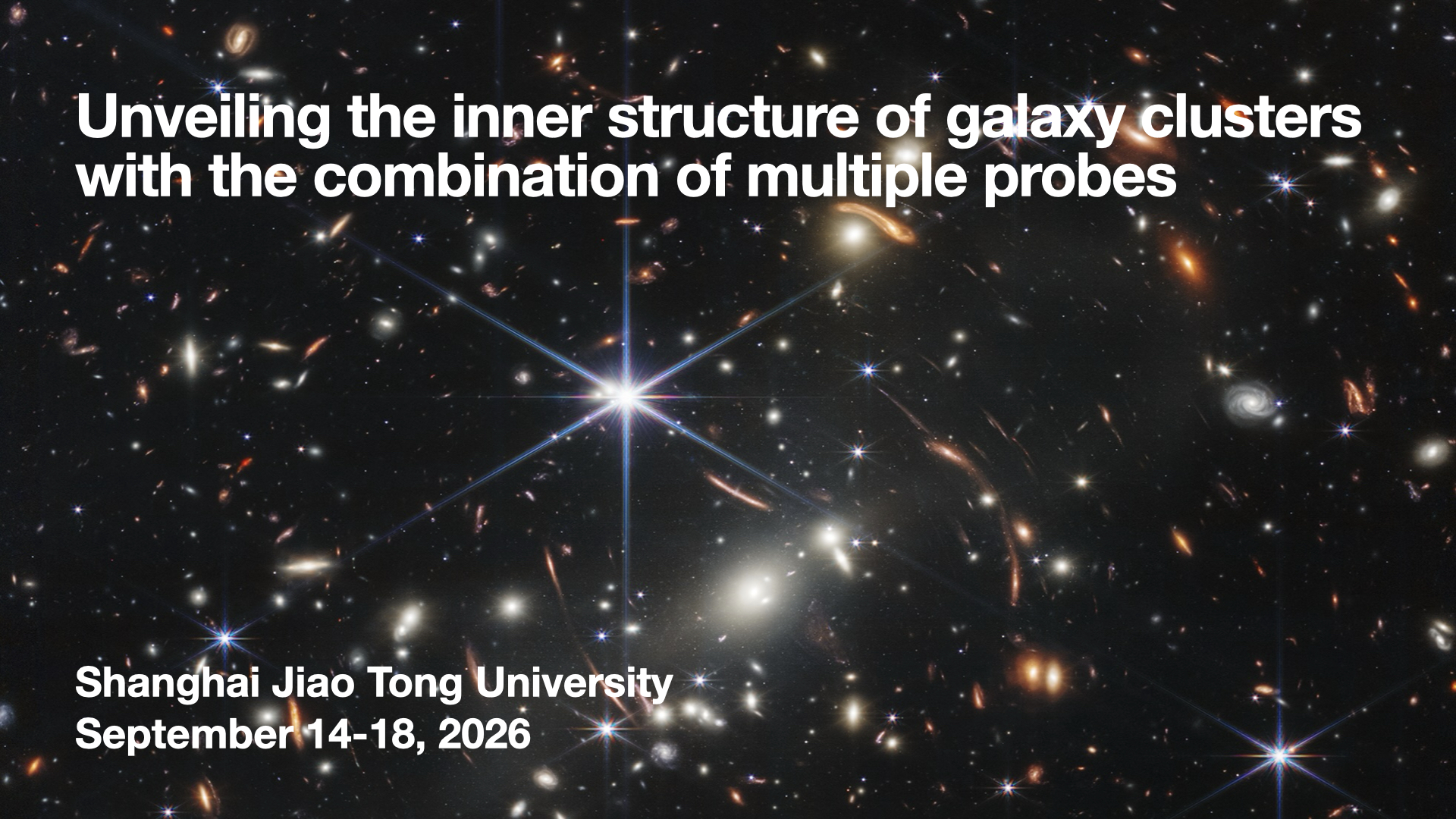
Unveiling the inner structure of galaxy clusters with the combination of multiple probes

Asia/Shanghai
203 (SJTU Xuhui Campus, Withub Building (慧谷科技楼))

203

SJTU Xuhui Campus, Withub Building (慧谷科技楼)

Shanghai, Xuhui District, West Guangyuan Road, 55. 上海市徐汇区广元西路55号。
Description

Galaxy clusters are among the most scientifically interesting objects in the Universe. They are hosts of extreme phenomena: the most massive galaxies, the most powerful active galactic nuclei (AGN), and the densest concentrations of dark matter are all found in clusters. Their abundance is sensitive to key cosmological parameters describing the growth of structure. As such, they offer unique opportunities for testing models of galaxy evolution, dark matter, and cosmology. 

A critical piece of information that is needed to make progress in our understanding of galaxy clusters is their mass, and, more generally, their density profile. Measuring the dark matter distribution is particularly important, because, while it accounts for most of the mass of a cluster, current constraints on it are relatively weak. There are multiple ways to measure cluster masses: strong gravitational lensing, weak gravitational lensing, galaxy dynamics, richness, X-ray emission, and the Sunayev-Zeldovich effect. Traditionally, these diagnostic probes have been employed in isolation, in large part because of a lack of data. However, current surveys such as Euclid and DESI, and upcoming ones such as 4MOST, the CSST and JUST, will soon provide large and overlapping photometric and spectroscopic datasets, covering thousands of galaxy clusters. These data will improve the constraining power of each individual method. More importantly, it will enable us to combine multiple probes, and reveal ever more complex details about the inner structure of galaxy clusters. Doing so in practice, however, is challenging, and requires a highly diverse range of expertise. In summary, a golden age of data abundance is opening up. In order to make the most out of it, clever ways to use these data need to be identified.

    • Welcome and introduction Room 203

      Room 203

    • Invited talks Room 203

      Room 203

      • 1
        Galaxy evolution in clusters: review
        Speaker: Benedetta Vulcani
      • 2
        Cluster strong lensing: review
        Speaker: Claudio Grillo
      • 3
        Cluster weak lensing: review
        Speaker: Raphael Gavazzi
    • 12:00 PM
      Lunch break
    • Invited talks Room 203

      Room 203

      • 4
        Cluster galaxy dynamics: review
        Speaker: Michele Pizzardo
    • Group work: Science goals Room 203

      Room 203

    • 3:00 PM
      Coffee break
    • Discussion: Science goals Room 203

      Room 203

    • Invited talks Room 203

      Room 203

      • 5
        Simulating and Modelling the strong lensing cluster in the Era of CSST

        The China Space Station Telescope (CSST) is China's next-generation space observatory currently under development. Featuring a 2-meter primary mirror, CSST is expected to detect hundreds of strong gravitational lensing galaxy clusters during its wide-field survey, providing a powerful probe for dark matter research. In preparation for CSST's cluster strong-lensing science goals, we have constructed a mock sample of galaxy cluster gravitational lenses for CSST and developed a pixel-level modeling pipeline capable of reconstructing background sources, including giant arcs. This report will present the construction of the mock sample, the technical framework of the pipeline, and their application prospects for dark matter studies.

        Speaker: Li Ran
      • 6
        Substructure in strong lensing and simulated clusters
        Speaker: Massimo Meneghetti
    • 10:30 AM
      Coffee break
    • Contributed talks Room 203

      Room 203

      • 7
        Simulation-Based Inference for Strong Lensing Clusters

        We present an automated, pixelated parameter-inference framework for strong lensing galaxy clusters based on simulation-based inference (SBI).

        Speaker: Shijiao Yin
      • 8
        Hierarchical Strong Lensing Modeling: Application to MACS J1206.2−0847

        Galaxy–galaxy strong lensing (GGSL) in galaxy clusters provides a unique probe of the mass distributions of individual cluster member galaxies. However, its definition and identification can depend sensitively on the assumed properties of these galaxies. We systematically investigate how the commonly adopted GGSL criterion responds to variations in the truncation radius and velocity dispersion of cluster member galaxies, and use these results to inform a physically motivated definition of GGSL with enhanced stability. We further explore the implications of this treatment for strong lensing modelling of the galaxy cluster MACS J1206.2−0847. In particular, we introduce a physically motivated hierarchical approach that relaxes the conventional assumption of scatter-free scaling relations for cluster member galaxies, allowing for intrinsic variations in their properties. As survey depth and angular resolution continue to improve, this approach may provide deeper insights into the properties of individual cluster member galaxies, and offering a new perspective on their population-level variations.

        Speaker: Li Cui (Shanghai Jiaotong University)
    • 12:00 PM
      Lunch
    • Contributed talks Room 203

      Room 203

      • 9
        Pixelated Reconstruction of the Carousel Lens: From Image Positions to Multiple Extended Sources

        Strong-lensing models of galaxy clusters are traditionally constrained by the positions of multiply imaged sources, leaving much of the information encoded in the resolved surface brightness of extended arcs unused. This talk presents a JAX-based modelling framework that combines multiple-image constraints with pixelated source reconstruction and GPU-accelerated Bayesian inference. Three modelling strategies are applied to the Carousel Lens: position-only modelling of five source systems, joint modelling of one pixelated extended source with independent image-position constraints, and simultaneous pixelated reconstruction of five sources at four distinct redshifts. The comparison demonstrates how extended surface brightness provides complementary constraints on the cluster mass distribution and improves the reconstruction of lensed source morphology. The talk also discusses the current limitations and prospects for large-scale pixelated modelling of cluster strong lenses.

        Speaker: XiangHao Ma
    • Group work: Individual probes: strengths and limitations Room 203

      Room 203

    • 3:00 PM
      Coffee break
    • Discussion: Individual probes: strengths and limitations Room 203

      Room 203

    • Invited talks Room 203

      Room 203

      • 10
        The internal and external structure of clusters in the Hector Galaxy Survey

        I will present a dynamical overview of the Hector Galaxy Survey clusters, based on mixture models that incorporate full dynamical modelling. This approach yields simultaneous masses for the main clusters and their subclusters, and assigns each galaxy a membership probability for every structure.

        Speaker: Matt Owers
    • Contributed talks Room 203

      Room 203

      • 11
        Gravitational Shear and Flexion in Abell 2744

        As the lensing signal increases near massive foreground clusters, higher-order effects become increasingly important, requiring an accurate treatment of the lens equation beyond the first-order approximation. While conventional galaxy shape estimators have been extensively studied in the perturbative regime of weak lensing, recovering large shear signals and higher-order distortions under realistic observing conditions remains challenging due to the presence of point spread functions (PSFs), noise, and intrinsic galaxy morphology variations. In particular, flexion, which describes the second-order distortion of galaxy images, provides valuable information about small-scale mass structures such as cluster subhaloes, but is difficult to measure because of its intrinsically weak signal and contamination from shape noise and shear.

        In this work, we develop improved methods for measuring gravitational shear and flexion in the environment of the massive galaxy cluster Abell 2744. For shear measurement, we introduce a non-perturbative approach capable of accurately recovering large shear signals (\gtrsim 0.5) under general observing conditions, including realistic PSF effects and noise. For flexion measurement, we develop a new estimator based on the gradient analysis of galaxy surface brightness, extending the theoretical framework to capture higher-order lensing distortions. The performance of these methods is validated using extensive simulations covering diverse PSF models, galaxy morphologies, and signal-to-noise ratios.

        Applying these techniques to JWST observations of Abell 2744, we aim to construct reliable shear and flexion maps around the cluster, enabling more precise reconstruction of the underlying dark matter distribution and providing constraints on small-scale structures such as galaxy cluster subhaloes.

        Speaker: jiarui sun
    • 10:30 AM
      Coffee break
    • Contributed talks: (Remote) Room 203

      Room 203

      • 12
        Kinematic Weak Lensing 1
        Speaker: Ned Taylor
      • 13
        Kinematic Weak lensing 2
        Speaker: Jiachuan Xu
    • 12:00 PM
      Lunch
    • Contributed talks Room 203

      Room 203

      • 14
        Extending Cluster Lensing Mass Inversion (Λ-CLUMI+): Combining Dynamics and Lensing for Accurate Galaxy Cluster Mass Reconstruction in the Infall Region

        Abstract.

        Speaker: Michele Pizzardo
    • Group work: Synergies - Part 1 Room 203

      Room 203

    • 3:00 PM
      Coffee break
    • Discussion: Synergies - Part 1 Room 203

      Room 203

    • Workshop dinner Sichuan Citizen (龙门阵茶屋川菜馆, 武康路店)

      Sichuan Citizen (龙门阵茶屋川菜馆, 武康路店)

      Wukang Road 378, 2F. 徐汇区武康路378号2楼
    • Contributed talks Room 203

      Room 203

      • 15
        Unveiling Faint Photometric Satellites in Galaxy Groups and Clusters

        I will present our measurements of faint photometric satellite luminosity and stellar mass functions in galaxy groups/clusters through a cross-correlation technique. The measurement can reach -7 in r-band absolute magnitude or 10^5.5 msun in the latest DESI data, which has a low-mass end slope consistent with CDM predictions. We will also show that MW satellite LF function is typical in the Local Volume, but statistically rare compared with other MW-mass systems in the more distant Universe, indicating our LV is an under-dense "local void".

        Speaker: Wenting Wang (SJTU)
      • 16
        Past and Present of Cluster Halo Assembly: the Central Galaxy’s Stellar Profile and its Satellite Population

        Deep wide-field imaging (e.g., HSC, Euclid) now reveals the low-surface-brightness outskirts of massive central galaxies and intra-cluster light, while cluster spectroscopic surveys (e.g., JUST) can better probe their satellite populations. Together, these two stellar components preserve complementary records of the host halo’s assembly history.  Using a halo-mass-complete sample of massive halos from the IllustrisTNG300 simulation, we develop a framework that reveals this record through these two complementary observables.  On the central stellar mass-richness plane, we show that the outskirt stellar mass of the central galaxy (e.g., $M_{\star,[50,100] kpc}$) rivals satellite richness as a halo mass proxy while tracing a different stage of assembly. At fixed halo mass, halos with more prominent outskirts but fewer satellites formed earlier and are more concentrated, a trend that can be tested directly with stacked galaxy–galaxy lensing. Resolving the central galaxy radially, we further show that its stellar profile is a stratified fossil record of halo assembly. Since stellar at larger radii tended to be accreted at later times, the stellar mass at larger radii retains a memory of the halo mass at later cosmic epochs, with this memory peaking at z~1  in the central core and at z~0.7  in the outer stellar halo, so that a single profile measurement maps out the halo’s growth across cosmic time. We also find that the central stellar mass identifies the most massive halo progenitors at intermediate redshift more faithfully than satellite richness.

        These results establish the BCG+ICL+Satellite as a practical, time-resolved probe of halo assembly history. In the era of multi-cluster-probes, spectroscopic membership and dynamical masses for thousands of clusters will suppress projection systematics and calibrate these stellar assembly tracers against weak lensing, clustering and other probes, opening a new window on halo assembly bias and cluster cosmology.

        Speaker: Shuo Xu (Department of Astronomy, Tsinghua University)
    • 10:30 AM
      Coffee break
    • Contributed talks Room 203

      Room 203

      • 17
        The Initial Mass Function and Stellar Populations in Massive Early-Type Galaxies

        Understanding how galaxies form and assemble is one of the central goals of astrophysics. By extracting detailed elemental abundance patterns and constraining the stellar initial mass function (IMF) from the integrated light of distant galaxies, we gain new insights into their star formation histories, stellar mass distributions, and dark matter content. In this talk, I will present results from the MASSIVE Survey on the stellar IMF and its spatial variations in nearby massive early-type galaxies. I will discuss the observed trends and their implications for the physical mechanisms that shape the IMF and drive the formation and assembly of the most massive galaxies in the local Universe.

        Speaker: Meng Gu (Tsinghua University)
      • 18
        Probing the Mass Distribution of M87 with Multiple Discrete Tracers

        We present a dynamical study of M87 using globular clusters (GCs) and ultra-compact dwarfs (UCDs) as discrete kinematic tracers. We construct separate axisymmetric Jeans anisotropic models (JAM) for different tracer populations, including blue GCs, red GCs, and UCDs. For each tracer population, we derive the enclosed mass at its characteristic radius and compare the independent mass constraints provided by different tracers. These measurements are then used to further constrain the mass profile of M87. We also investigate differences in the kinematics and orbital anisotropy of the individual tracer populations.

        Speaker: Qimin Zhang
    • 12:00 PM
      Lunch break
    • Contributed talks Room 203

      Room 203

      • 19
        Forward modeling galaxy infall kinematics around clusters

        Galaxy infall kinematics (GIK) around clusters provide a valuable probe of dynamical mass profiles, particularly the characteristic infall velocity. Building on Zu & Weinberg (2013), we propose an improved forward modeling methodology for the redshift-space distortions of galaxies around central clusters. Specifically, we will calibrate a parametric GIK model using the FLAMINGO simulation. By leveraging both the hydrodynamical and dark-matter-only suites, we will investigate the mass dependence of the GIK and test its sensitivity to baryonic physics. These simulation-anchored results will inform our interpretation of the redshift-space cluster–galaxy cross-correlation signals measured in the DESI DR2 BGS catalogs, providing a complementary approach to stacked weak-lensing measurements for cluster mass calibration.

        Speaker: Yunzhe Gu (Shanghai Jiao Tong University)
      • 20
        The depletion radius of DM halos traced by luminous objects in TNG300

        Please schedule my talk during the first few days if that is possible. Thanks!

        Speaker: Mingtao Yang
    • Group work: Synergies - Part 2 Room 203

      Room 203

    • 3:00 PM
      Coffee break
    • Discussion: Synergies - Part 2 Room 203

      Room 203

    • Contributed talks Room 203

      Room 203

      • 21
        Direct Measurement of Galaxy Assembly Bias from Galaxy-Cluster Cross-correlations

        Understanding galaxy assembly bias is crucial for deriving unbiased cosmological constraints from Stage
        IV surveys such as the Dark Energy Spectroscopic Instrument (DESI). Taking advantage of the state-of-the-art
        DESI group catalog, we develop a robust method to directly measure galaxy assembly bias, parametrized by
        $Q_{\rm env}$, for a volume-limited galaxy sample at redshift $z\in[0.05,0.2]$ from the DESI Bright Galaxy Survey. This
        is achieved by examining how the halo occupation distribution (HOD) of galaxies depends on the large-scale
        overdensity environment $\delta_g$. For each subsample of groups binned by total luminosity at fixed $\delta_g$, we develop a
        novel method to measure the occupation number $N_{\rm gal}$ using the group-galaxy cross-correlation function, while
        weak gravitational lensing constrains the average halo mass Mh. By comparing the HOD $N_{\rm gal}(Mh)$ between
        high- and low-δg environments, we obtain a stringent constraint of $Q_{\rm env}=−0.06\pm0.13$, statistically consistent
        with no galaxy assembly bias ($Q_{\rm env}=0$). Our work provides a direct method of measuring the HOD of any tracer
        population without assuming an arbitrary cosmology, offering a straightforward approach to characterizing
        galaxy assembly bias for precision cosmology in DESI and future surveys.

        Speaker: Zhiwei Shao (Shanghai Jiao Tong University)
      • 22
        First Observational Evidence for Split Infall Flow of Cosmic Filaments into Clusters

        Velocity fields in the cosmic web are fundamental to structure formation but remain difficult to observe directly beyond the linear regime. Here we present observational evidence that galaxy filaments connecting pairs of galaxy clusters undergo a split infall, with opposite velocity flows toward the two clusters. Using spectroscopic galaxies from the Sloan Digital Sky Survey, we isolate the internal filament velocity field by subtracting its rigid-body background motion and Hubble flow, and detect this effect at a significance greater than 5σ across a wide range of cluster and filament selections. The measured velocity profile exhibits a sign reversal near the filament midpoint and a maximum infall amplitude of ∼ 30 km/s (∼ 20 km/s projected onto the line-of-sight) for clusters of mass ∼ $10^{14.3}$M⊙, substantially lower than expected for infall from an average cosmic environment. Multiple results on density-velocity correlation, mass-dependency, and validation with simulations indicate that filaments dynamically respond to competing gravitational potentials rather than acting as passive mass transport channels. Our results establish a new observational window on quasi-linear velocity fields in the cosmic web and provide a promising probe of mass measurement, testing gravity and velocity reconstruction with upcoming wide-field spectroscopic surveys.

        Speaker: Ji Yao (Shanghai Astronomical Observatory)
    • 10:30 AM
      Coffee break
    • Discussion: Action plan Room 203

      Room 203