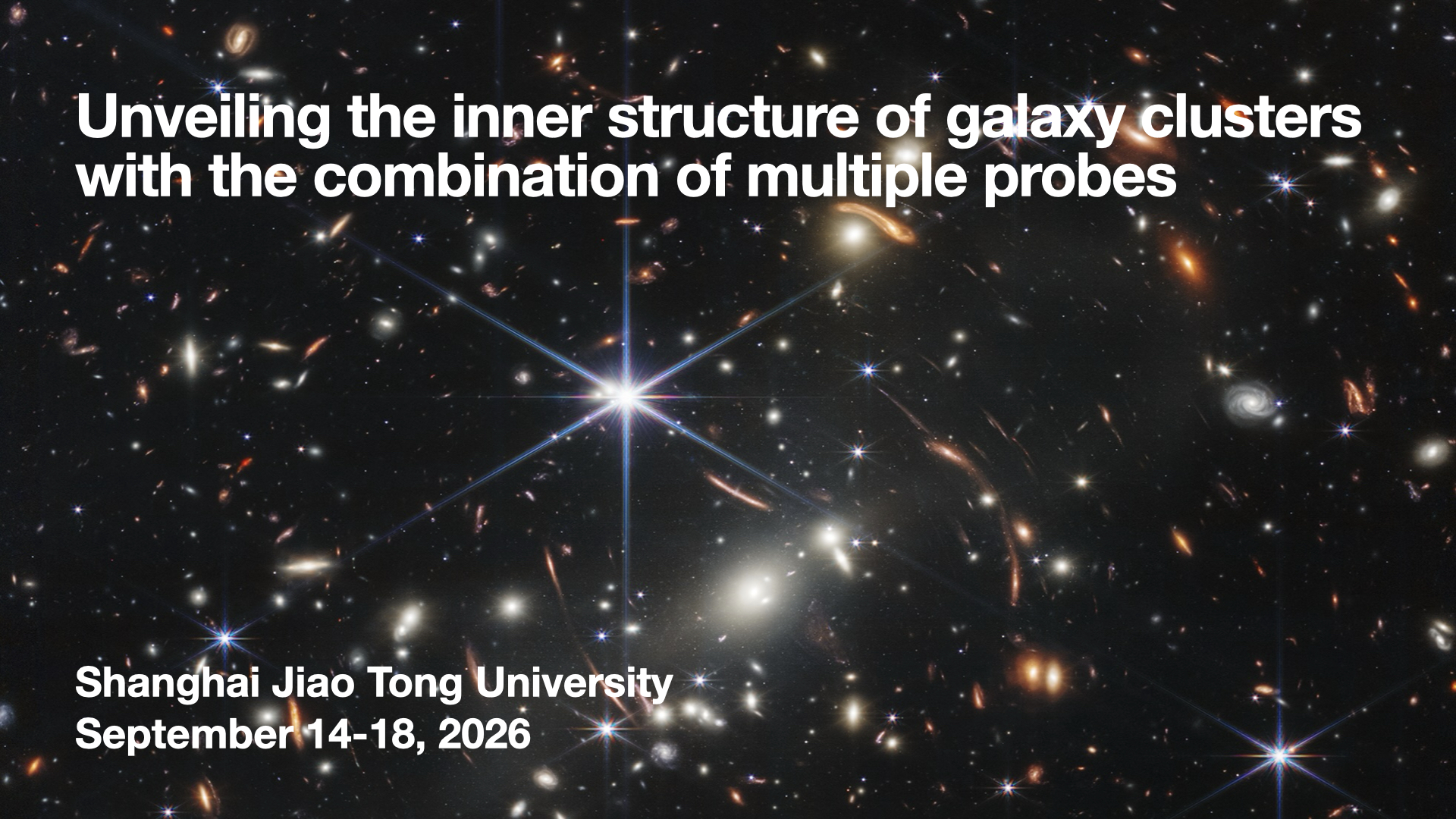
Galaxy clusters are among the most scientifically interesting objects in the Universe. They are hosts of extreme phenomena: the most massive galaxies, the most powerful active galactic nuclei (AGN), and the densest concentrations of dark matter are all found in clusters. Their abundance is sensitive to key cosmological parameters describing the growth of structure. As such, they offer unique opportunities for testing models of galaxy evolution, dark matter, and cosmology.
A critical piece of information that is needed to make progress in our understanding of galaxy clusters is their mass, and, more generally, their density profile. Measuring the dark matter distribution is particularly important, because, while it accounts for most of the mass of a cluster, current constraints on it are relatively weak. There are multiple ways to measure cluster masses: strong gravitational lensing, weak gravitational lensing, galaxy dynamics, richness, X-ray emission, and the Sunayev-Zeldovich effect. Traditionally, these diagnostic probes have been employed in isolation, in large part because of a lack of data. However, current surveys such as Euclid and DESI, and upcoming ones such as 4MOST, the CSST and JUST, will soon provide large and overlapping photometric and spectroscopic datasets, covering thousands of galaxy clusters. These data will improve the constraining power of each individual method. More importantly, it will enable us to combine multiple probes, and reveal ever more complex details about the inner structure of galaxy clusters. Doing so in practice, however, is challenging, and requires a highly diverse range of expertise. In summary, a golden age of data abundance is opening up. In order to make the most out of it, clever ways to use these data need to be identified.